Coming soon · Lakewood, WA
Empowered Developmental Preschool
The years before kindergarten build the skills everything else stands on. We don’t wait for them to show up. We teach them, on purpose, through play.
We’re not open for enrollment yet. Join the waitlist to hear first when we are, with no obligation.
Why this preschool
Most preschools hope these skills show up. We teach them.
By kindergarten, children are expected to follow routines, ask for help, play with friends, wait their turn and handle a disappointing “no.” Most preschools assume these skills will develop on their own.
For many children, they do. For others, they need a little more. And too often, families are told to wait and see, while their child spends another year feeling frustrated, left out or misunderstood.
At Empowered, we don’t leave it to chance. Every day is designed to explicitly teach the skills that help children feel capable, confident and connected.
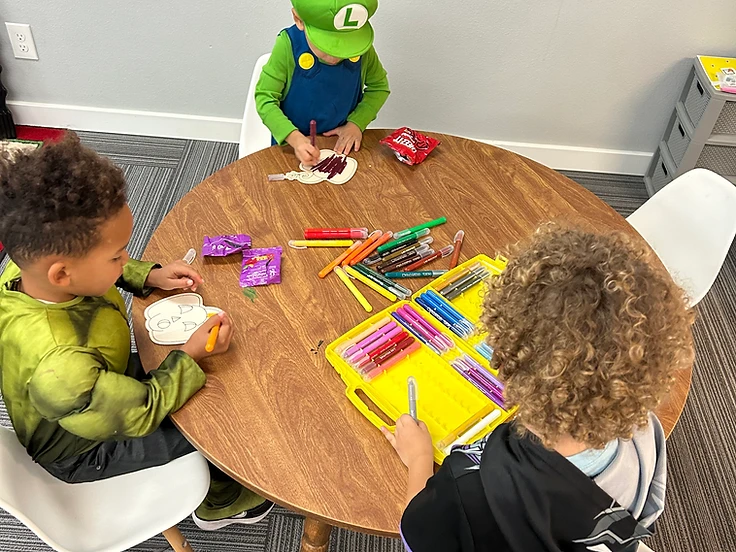
The early childhood window
The first five years are when skills are easiest to build.
The brain is wiring itself
A young child’s brain builds connections faster than at any other time in life. Skills practiced now become the foundation for learning later.
Habits are still flexible
The longer a child relies on a workaround, like a meltdown instead of words, the stronger that habit gets. Teaching a better way early is easier than undoing it later.
Confidence compounds
A child who walks into kindergarten able to ask, join and try starts school feeling capable. That feeling shapes everything that comes after.
What we teach
Four skill areas that make kindergarten (and life) easier.
Woven into every play activity, routine and transition of the day.
Adaptive skills
What it looks like
Hanging up a backpack, opening a snack, washing hands, following a morning routine, asking for help.
Why it matters
These are the skills that let a child feel capable in a classroom. Kindergarten teachers expect them on day one.
Communication
What it looks like
Asking for what they need, saying “stop” or “my turn,” answering a question, telling a grown-up something happened.
Why it matters
When a child can say it, they don’t have to show it. Clear communication is what replaces a lot of hard behavior.
Social skills
What it looks like
Joining a group, sharing space, taking turns, noticing a friend’s feelings, handling “no” from a peer.
Why it matters
Friendships don’t just happen for every child. Many need the steps broken down and practiced with real peers.
Play skills
What it looks like
Building on a friend’s idea, pretending, staying with an activity, trying a new way to play.
Why it matters
Play is how young children learn language, problem-solving and flexibility. It’s the classroom inside the classroom.
How we teach
Developmental psychology, behavior science and a lot of play.
Our classroom is guided by a BCBA, so the way we teach is grounded in how children actually learn. It just looks like a really good morning at preschool.
1
Break it down
We look at each skill in small, teachable steps, so we know exactly where your child is and what comes next.
2
Teach it on purpose
We model it, practice it, and build it into play and routines, instead of waiting for it to show up.
3
Celebrate it
We notice and reinforce every step forward, so new skills get stronger and stick.
4
Make it last
We practice with different friends, adults and activities, so the skill works in real life, not just at school.
Who it’s for
One classroom. Room for every kind of learner.
Our program welcomes children with and without developmental differences. Here’s who it was designed for.
Your child needs a little extra time
You’ve noticed your child is a bit behind with talking, playing with friends or handling routines, but there’s no diagnosis. You don’t want to just wait and see. Here, skills are taught on purpose, so your child gets real support now, with no label required.
You want support, but not an IEP right now
Maybe you’re not ready to go through the school district, or an IEP doesn’t feel like the right fit yet. Our small classroom gives your child structured teaching, BCBA oversight and a team that understands development, in a private preschool setting.
You want a great private preschool
Your child is right on track, and you want a small, warm program that does more than keep them busy. Every child here learns the skills that make kindergarten easier, and grows up seeing that friends learn in different ways.
Why learning together works
- Children learn from each other. Peers are some of the best teachers of language and play.
- Every child gets explicit teaching, not just the children who “need it.”
- Children grow empathy and flexibility by learning alongside friends who are different from them.
- No child is singled out. Support is simply part of how the whole classroom works.
Program details
Small on purpose.
A small group means every child is known, every skill is noticed, and no one gets lost in the crowd.
Ages
About 2½–5
Schedule
Mon–Thu, 8:30 AM – 12:00 PM
Class size
Up to 10 children
Staffing
Teacher + assistant (about 1:5)
Oversight
Board Certified Behavior Analyst (BCBA)
Good to know
Toilet trained by age 4 (little ones still learning are welcome) · parents send snacks · no naps or before/after care
Common questions
Questions families ask.
Join the waitlist
Give your child a head start on kindergarten.
Tell us a little about your family, and you’ll be the first to hear about tours and enrollment. Please don’t include medical details here.
What happens after you join
1. You join the list
It takes a minute, and it's free.
2. No spot reserved, no commitment
Joining does not reserve a spot and does not commit you to anything.
3. You hear from us first
We'll email you when program details and enrollment information are ready — interest-list families hear first.
Interest-list perk: Interest-list families get first access to tours and enrollment before anything is shared publicly.